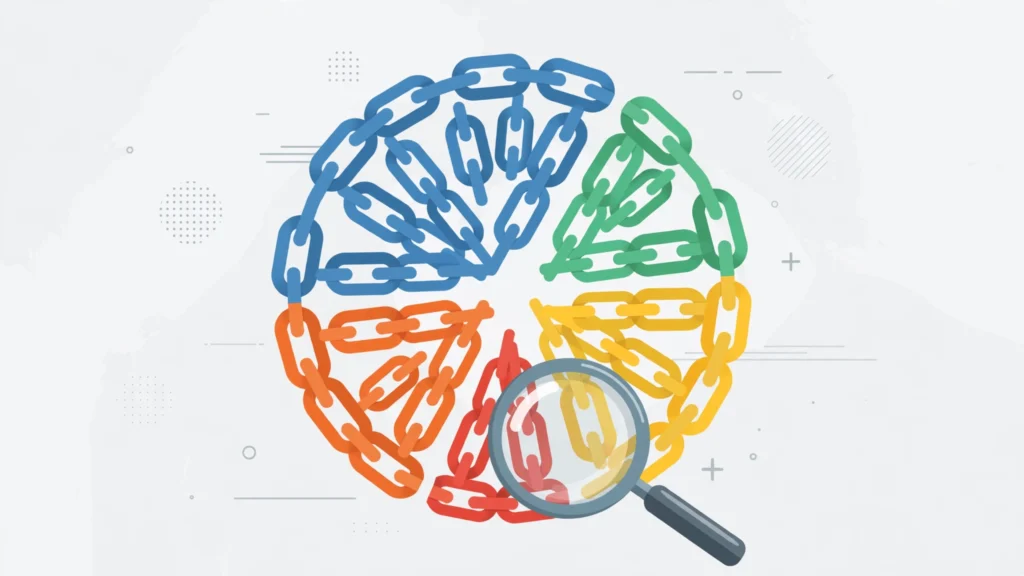
Of everything that separates a safe link-buying campaign from one that gets filtered, anchor text ratio is the most underestimated. Buyers obsess over DR, traffic, and price — then point every purchased link at their money page with the same keyword-rich anchor and wonder why rankings stall or drop. Google’s systems do not read your invoices, but they read your anchor patterns with perfect clarity.
This ratio is simply the percentage breakdown of your backlinks by anchor type: branded, naked URL, generic, partial match, and exact match. Get the distribution right and your bought links blend into a natural-looking profile. Get it wrong and even links from legitimate publications can trigger algorithmic suppression. This guide gives you the safe distribution for 2026, how to audit your current profile, and exactly what to specify when you order links.
Why Anchor Text Ratio Matters More Than Ever
Anchor text tells Google what the linked page is about. A link with the anchor “project management software” pointing at your product page is a relevance vote for that keyword — which is precisely why it is powerful, and precisely why it is dangerous in excess. No natural link profile has 40% of its links using the same commercial keyword, because real people linking organically use brand names, URLs, and generic phrases far more often.
Google has never published an official ideal ratio, and honest SEOs will tell you no universal number exists — a law firm earns different anchors than a fashion retailer. But pattern analysis of top-ranking sites across competitive niches converges on a consistent shape: branded anchors dominate, exact-match anchors are a small minority, and everything else fills the middle. When your bought links follow that shape, they reinforce rankings. When they deviate sharply, they become the footprint that gives the campaign away.
This matters even more for buyers because purchased links are the ones you control. You cannot dictate how the organic web anchors its links to you, but every guest post and niche edit you order is an anchor you choose. Wasting that control on repeated exact-match anchors is the most common unforced error in link buying.
The 5 Anchor Types Every Buyer Must Know
Before the numbers, the vocabulary:
- Branded — your company or product name (“Acme CRM,” “the team at Acme”). The safest and most natural anchor type.
- Naked URL — the raw address as clickable text (“acme.com/pricing”). Common in directories, citations, and forum mentions.
- Generic — non-descriptive phrases (“click here,” “this guide,” “learn more,” “read the full report”). Weak for relevance, excellent for naturalness.
- Partial match — keyword variations with context (“this project management guide,” “Acme’s CRM software review”). The workhorse of safe commercial link building.
- Exact match — the precise keyword you want to rank for (“project management software”). The most powerful and the most dangerous.
There are also hybrids buyers encounter: brand + keyword (“Acme’s project management software”) behaves like a mild partial match, and long-tail natural anchors (“where I learned to manage remote teams”) behave like generic. When auditing, bucket hybrids into the nearest category.
Anchor Text Ratio: The Safe Distribution for 2026
Based on analysis of top-ranking sites across competitive niches, here is the distribution that consistently performs without triggering penalties. Treat these as guardrails, not gospel — the exact numbers shift by niche, but the shape should hold:
| Anchor type | Safe range | Role in the profile |
|---|---|---|
| Branded | 40–60% | The dominant category by a wide margin |
| Naked URL | 10–20% | Directories, citations, profiles |
| Generic | 10–15% | Keeps the profile looking authentically human |
| Partial match | 10–20% | Safe relevance signals to commercial pages |
| Exact match | 3–10% | Powerful; dangerous above this range |
Two thresholds deserve memorization. First: if exact-match anchors exceed 15% of your profile, treat it as an over-optimization flag and fix it before buying another link. Second: if branded anchors fall below 20%, your profile reads as built rather than earned, because real brands are mostly referenced by name.
For new websites, skew even more conservative: 60%+ branded, under 5% exact match for the first six months. Young domains have no trust buffer, so the camouflage must be thicker. Our guide to safe link pacing pairs naturally with these ratios.
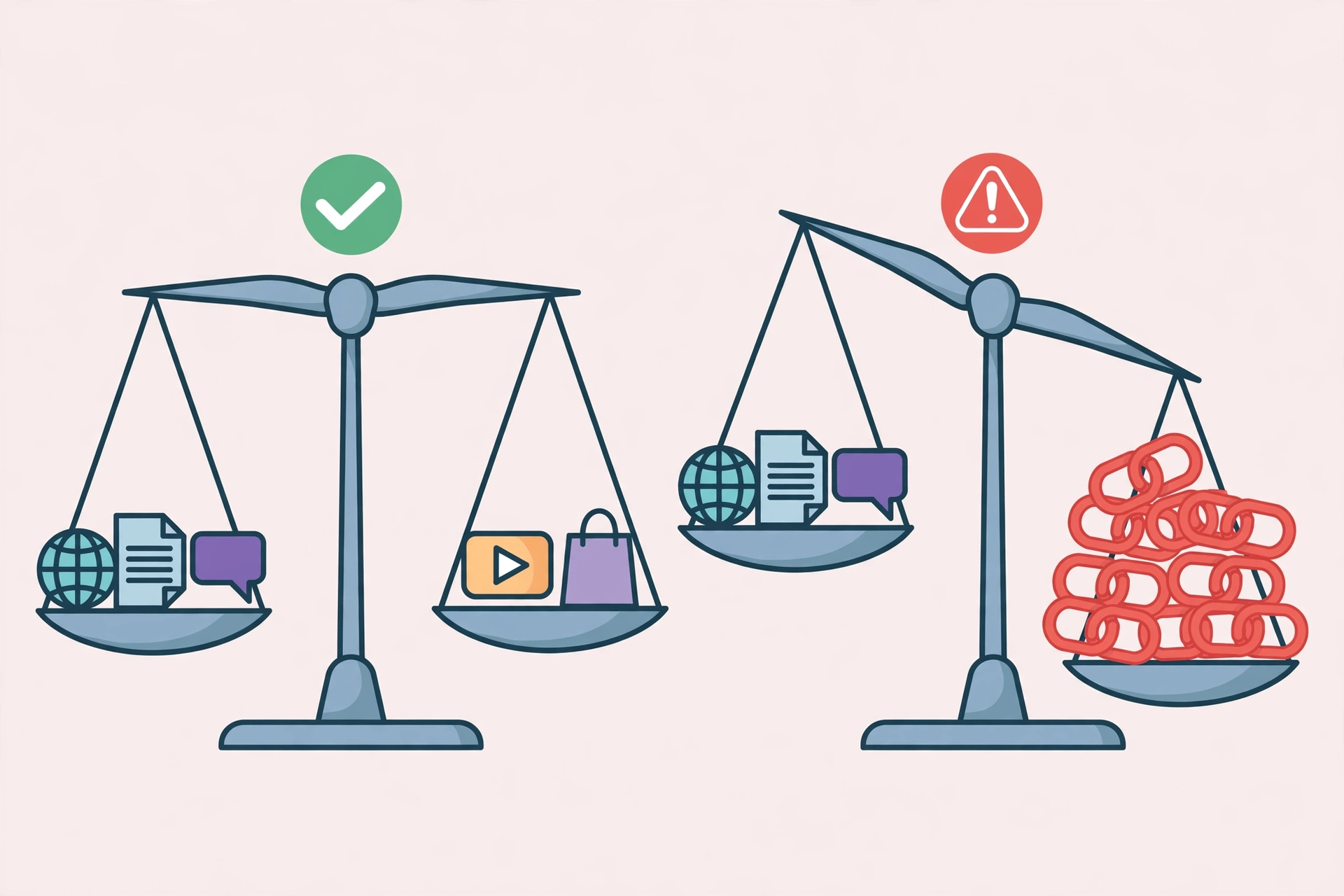
Safe Profile vs Risky Profile: A Worked Example
Numbers are abstract; here is what a safe versus risky distribution looks like on a fictional SaaS company with 100 backlinks.
Safe profile:
- 50 branded (“Acme,” “the Acme team,” “Acme CRM”)
- 14 naked URL (“acme.com,” “acme.com/pricing”)
- 13 generic (“click here,” “this guide,” “learn more”)
- 16 partial match (“project management guide,” “Acme’s CRM review”)
- 7 exact match (“project management software”)
Risky profile:
- 15 branded
- 5 naked URL
- 5 generic
- 25 partial match
- 50 exact match (“project management software,” “best project management software,” “affordable project management software”)
The risky profile has half its backlinks using keyword-rich anchors. Even if every one of those 100 links came from a legitimate publication, the anchor pattern alone can trigger algorithmic suppression — Google’s systems see a distribution that never occurs naturally and discount the relevance signals accordingly. This is the profile most commonly produced by buyers who order “10 guest posts with exact-match anchors” on repeat.
How to Audit Your Current Anchor Text Ratio
Before you buy another link, know where you stand. The audit takes about 30 minutes:
1. Export your anchors. Pull your backlink anchor data from Ahrefs, Semrush, Google Search Console’s links report (free, though less complete), or a dedicated anchor text analysis tool. You need the anchor text of each linking domain, deduplicated by domain — ten links from one domain with the same anchor count as one signal, not ten.
2. Categorize every anchor. Bucket each into branded, naked URL, generic, partial match, or exact match. A spreadsheet with five columns works fine. Be honest about partial vs exact: “best CRM for startups” targeting “CRM software” is partial, not exact.
3. Calculate the percentages. Divide each bucket by the total referring domains. Compare against the safe ranges above.
4. Flag the violations. Exact match above 15%? Branded below 20%? One anchor phrase repeated across 10+ domains? Each is a fix-before-you-continue item.
5. Plan the dilution. You rarely need to remove links. Instead, plan your next 20–30 acquired links to be deliberately branded, URL, and generic anchors pointing at your homepage, about page, and blog content. New diverse links dilute old concentrated ones — the ratio is a moving average, and every link you add moves it.
Repeat the audit quarterly. Anchor drift is gradual and invisible without measurement, and it is the number one reason established campaigns slowly lose effectiveness.
Specifying Anchors When You Buy Links
This is where the anchor text ratio becomes operational. Every link order you place should include explicit anchor instructions, because vendors default to whatever you asked for last — and most buyers last asked for exact match.
A safe anchor brief for a batch of 10 guest posts might read: 5 branded (rotate 2–3 brand variations), 2 naked URL, 1 generic, 2 partial match (specify the exact phrases). Zero exact match in this batch — your exact-match quota is spent sparingly, on your highest-authority placements, a few times per year.
Additional ordering rules that protect the ratio:
- Vary target URLs. Do not point all ten links at one page. Spread across homepage, 2–3 commercial pages, and 2–3 informational pages. URL concentration amplifies anchor concentration.
- Never repeat the same anchor twice in one batch. Ten links with ten different anchors always beat ten links with one anchor, even if all ten are partial match.
- Match anchor to page intent. Branded and URL anchors to the homepage; partial match to commercial pages; generic to blog content. This mirrors how organic links actually distribute.
- Reserve exact match for your best links. If you are allowed 5 exact-match anchors per 100 links, spend them on the highest-DR, most relevant placements — not on directory listings.
- Audit the delivered anchors. Vendors sometimes substitute anchors. Check every delivered link against your brief before the campaign closes.
Buyers choosing between niche edits and guest posts should note that the same anchor rules apply to both — a niche edit with an exact-match anchor counts exactly the same in your ratio as a guest post with one.
Over-Optimization: Signs, Causes, and Fixes
Over-optimization is what happens when your anchor text ratio skews keyword-heavy for long enough that Google’s systems stop trusting the relevance signals. The signs are distinctive: rankings that plateau despite new links, gradual declines on the exact keywords you targeted most aggressively, and competitors with weaker link profiles outranking you on your own money terms.
The cause is almost always buyer behavior, not bad luck: repeated exact-match orders, the same anchor brief copy-pasted across vendors, or an old campaign from the days when 30% exact match worked. (It did, briefly, years ago. It does not now.)
The fix is dilution, not deletion. Disavowing your own paid links is rarely necessary and often counterproductive — as our backlink safety guide explains, Google already discounts obvious manipulation, so the practical move is to change what the profile looks like going forward. Pause all exact-match ordering for 2–3 months, acquire 20–30 branded/URL/generic links to diverse pages, and re-audit. Most profiles recover their trajectory within one to two quarters once the ratio normalizes.
One preventive habit beats every cure: cap exact-match anchors as a percentage of referring domains, not as an absolute number. “Under 8% of referring domains” scales with your profile; “no more than 5 exact anchors” breaks the moment you grow.

Anchor Text and AI Search
A question buyers increasingly ask: does any of this matter for ChatGPT, Perplexity, and Google AI Overviews? The honest answer is that anchor text ratio matters indirectly. AI answer engines do not compute anchor distributions the way Google’s classic ranking systems do, but they heavily weight brand recognition, citation frequency, and entity authority — all of which are built by the branded anchors and diverse mentions that a healthy ratio produces.
A profile with 60% branded anchors means 60% of your link graph reinforces your brand as an entity. That entity strength is what gets you cited in AI answers. The buyer optimizing purely for exact-match anchors is optimizing for a ranking system that is slowly giving way to one that rewards being a recognized, widely-referenced brand. The safe anchor text ratio of 2026 is, conveniently, also the AI-visibility-friendly one.
Frequently Asked Questions
What is a safe anchor text ratio?
A widely used safe distribution is 40–60% branded anchors, 10–20% naked URLs, 10–15% generic anchors, 10–20% partial match, and 3–10% exact match. These are guardrails rather than strict rules — the exact numbers vary by niche — but the shape should hold: branded dominates, exact match is a small minority. New websites should skew even more conservative, with 60%+ branded and under 5% exact match.
What percentage of exact match anchors is safe?
Keep exact-match anchors between 3–10% of your referring domains, and treat 15% as a hard over-optimization flag. Exact match is the most powerful anchor type for relevance but the most dangerous in excess — a profile where half the links use the target keyword is a pattern that never occurs naturally and can trigger algorithmic suppression even when the links themselves come from legitimate sites.
Do branded anchors really need to be 50% of my profile?
In most niches, yes — or at least the largest single category at 40–60%. Real brands are referenced by name far more often than by keyword: think about how people naturally link to companies they mention. If branded anchors fall below 20%, the profile reads as built rather than earned. Branded anchors are also what build the entity recognition that feeds AI search citations.
How do I check my current anchor text ratio?
Export your backlink anchors from Ahrefs, Semrush, or Google Search Console, deduplicate by referring domain, and bucket each anchor into branded, naked URL, generic, partial match, or exact match. Calculate each bucket’s percentage of total referring domains and compare against the safe ranges. Repeat quarterly, since anchor drift is gradual and invisible without measurement.
What is over-optimization in anchor text?
Over-optimization is a link profile skewed so keyword-heavy that search engines stop trusting its relevance signals — typically exact-match anchors above 15% or branded below 20%. Symptoms include ranking plateaus despite new links and declines on aggressively targeted keywords. The fix is dilution: pause exact-match ordering and acquire 20–30 branded, URL, and generic links to diverse pages over 2–3 months.
Does anchor text still matter in 2026 with AI search?
Yes, though the mechanism is shifting. Classic ranking systems still use anchor text as a relevance signal, and over-optimized profiles can still trigger suppression. For AI answer engines, the branded anchors and diverse mentions in a healthy ratio build the entity authority and citation frequency that get brands referenced in AI answers. The safe ratio serves both systems.
Order Links With the Ratio Built In
The easiest way to keep your anchor text ratio safe is to specify anchors on every order — and to buy from a marketplace that lets you control them. On GuestPostOffice, you set the exact anchor text for every placement across vetted publications with verified traffic. Browse the marketplace and place an anchor-controlled order today.