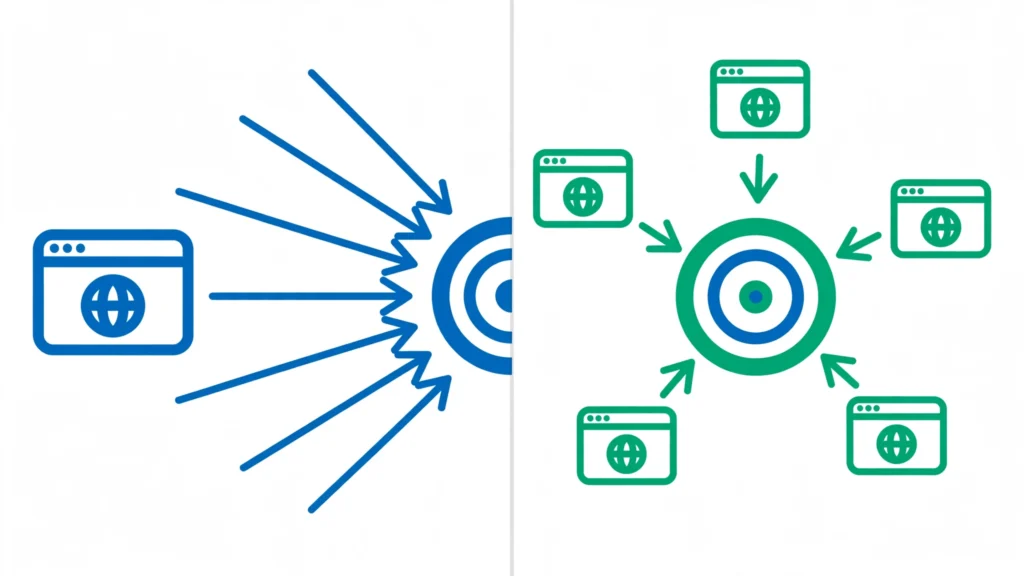
If you have ever opened an SEO report and wondered about referring domains vs backlinks, you are not alone. The two numbers sit side by side in every tool — Ahrefs, Semrush, Moz — yet they rarely match, and most site owners have no idea which one actually predicts rankings. Confusing the two leads to real money being wasted: people celebrate a backlink count in the thousands while their rankings refuse to move, because the number that matters has barely budged.
A backlink is a single hyperlink from another website pointing to your site. A referring domain is the unique website that sent that link. One blog can send you fifty backlinks and still count as exactly one referring domain. That simple distinction reshapes how you should plan, buy, and measure every link campaign you run.
Referring Domains vs Backlinks: The Core Difference
The referring domains vs backlinks distinction sounds subtle, but it changes everything about link building. Think of a referring domain as a person and backlinks as the number of times that person recommends you. One person recommending you twenty times is nice; twenty different people each recommending you once is far more convincing. Google thinks the same way.
Here is the comparison in plain terms:
| Aspect | Backlinks | Referring Domains |
|---|---|---|
| Definition | Individual hyperlinks pointing to your site | Unique websites those links come from |
| How counted | Every link counts, even repeats from one site | Each domain counts once, no matter how many links it sends |
| Example | One news site links to you from 10 articles = 10 backlinks | Those same 10 links = 1 referring domain |
| SEO role | Page-level strength for the linked URL | Domain-level trust and authority signal |
| Diminishing returns | High — extra links from the same site add little | Low — each new domain is a fresh vote of confidence |
| Manipulation risk | Easy to inflate with sitewide or footer links | Harder to fake at scale, so Google trusts it more |
Every SEO tool reports both numbers because they answer different questions. Total backlinks tell you the volume of your link profile; referring domains tell you its diversity. A healthy profile needs both, but when budgets are limited, diversity is where the ranking power lives.
Why Referring Domains Carry More Weight in 2026
In the referring domains vs backlinks debate, diversity wins for one simple reason: each new referring domain is an independent editorial decision. When a different website links to you, a different editor, author, or site owner decided your content was worth referencing. Google reads that as a broad consensus of trust. Ten links from one site are, at best, one person’s enthusiastic opinion.
Large-scale correlation studies of search results have repeatedly found that referring domain count tracks with rankings far more strongly than raw backlink count. Sites sitting on page one of competitive queries almost always have links from more unique domains than the sites below them. That pattern has held for years because it mirrors how Google’s own quality guidelines think: genuine popularity looks like many independent sources, not one loud one.
That is why the referring domains vs backlinks conversation matters most when you are deciding where to spend money. Paying for five links from five new, relevant publications will almost always move the needle more than paying for five more links from sites that already link to you. The first link from a domain is the most valuable one you can earn from that source; every link after it contributes progressively less. If you want a deeper technical walkthrough, Mangools’ referring domains guide breaks down exactly how the metric is measured and why tools rank it above raw link counts.

What Your Total Backlink Count Still Tells You
None of this means backlink count is useless. Total backlinks add useful depth-of-coverage detail on top of the diversity signal. Multiple links from the same strong domain can pass additional relevance through varied anchor text, point at different pages of your site, and drive real referral traffic — all of which have value beyond raw ranking math.
Backlink count also works as a diagnostic. A sudden spike in total backlinks with no growth in referring domains often means something automated happened: a sitewide footer link went live, a template change duplicated your link across hundreds of pages, or a scraper copied content linking back to you. Those situations deserve attention because inflated link counts without new referring domains can look manipulative.
The practical takeaway is a hierarchy, not an either-or. Grow referring domains first, then let backlink count grow naturally as a byproduct of deeper coverage. When you are evaluating a link opportunity, ask the domain question before the link question: has this website ever linked to me before? If the answer is no, the placement is worth more to you than one from a familiar source. Keep this referring domains vs backlinks hierarchy in mind every time you review a link report.
Reading the Ratio: Backlinks per Referring Domain
Reading the referring domains vs backlinks ratio of any site — its own or a competitor’s — is one of the fastest ways to judge profile health. Divide total backlinks by referring domains and you get the average number of links each linking site sends. Most natural profiles sit between 3 and 10 backlinks per referring domain.
| Backlinks per Referring Domain | What It Usually Means | Verdict |
|---|---|---|
| 1 – 3 | Mostly single editorial links from many sites | Excellent diversity, the ideal shape |
| 3 – 10 | Natural mix of editorial links plus some repeated coverage | Healthy and normal |
| 10 – 20 | Some sitewide, author-bio, or multi-page linking present | Worth reviewing, not alarming on its own |
| 20+ | Footer, sidebar, template, or widget links inflating the total | Unnatural pattern — audit before buying more links |
A profile with 8,000 backlinks from 200 referring domains is dramatically weaker than one with 800 backlinks from 800 domains, even though the first number looks forty times better in a report. This is the mistake vanity metrics create: vendors sell link counts, but Google rewards domain diversity. When someone pitches you “1,000 backlinks for $99,” the ratio table above tells you exactly what that package is.
Running a referring domains vs backlinks audit on your own site each quarter keeps this ratio honest and your strategy grounded.
How to Check Both Metrics in Your Own Tools
Every major SEO platform surfaces both numbers, usually on the same dashboard. In Ahrefs’ Site Explorer, the overview shows “Backlinks” and “Referring domains” as separate headline stats, with a graph of each over time. Semrush’s Backlink Analytics does the same, and Google Search Console shows your top linking sites under the Links report — those are your referring domains, straight from Google’s own data.
When auditing, look at trends rather than snapshots. A referring domain count that climbs steadily month over month is the signature of a working link strategy. A flat referring domain line with a climbing backlink line means you are deepening existing relationships instead of expanding your footprint — fine for a while, but not a growth engine. Set a monthly target for new referring domains, not new backlinks, and your strategy will stay honest. A monthly referring domains vs backlinks check takes ten minutes and tells you more than any single backlink count ever will.

Competitor benchmarking works the same way. Pull the referring domain counts of the pages ranking in the top five for your target keyword and you have a realistic target range for that specific query. Low-competition keywords can be winnable with under ten quality referring domains; competitive commercial terms often need hundreds. This is far more actionable than any generic “how many backlinks do I need” advice, because it is calibrated to your actual battlefield.
How to Grow Referring Domains Instead of Just Backlinks
A smart referring domains vs backlinks strategy puts new domains first in every tactic you run. Guest posting remains the most reliable engine for this: each placement on a new publication is a new referring domain by definition, and you control the relevance, anchor text, and linked page. Our breakdown of niche edits vs guest posts covers which format fits different budgets, but both add referring domains when placed on sites that have never linked to you.
Digital PR is the highest-ceiling tactic for domain diversity. One genuinely newsworthy study, dataset, or expert survey can earn links from dozens of publications that would never accept a guest post pitch. The cost per referring domain is often lower than outreach at scale, though results are less predictable. A balanced program runs steady guest posting for predictable growth and layers digital PR campaigns on top for spikes. Every tactic in this referring domains vs backlinks playbook works best when new domains are the explicit target.
Three rules keep domain growth safe and effective:
- Prioritize unlinked domains. Before ordering any placement, check whether the site already links to you. New domains outrank repeat domains in value almost every time.
- Stay topically relevant. Twenty referring domains from your own niche beat two hundred from unrelated directories. Relevance multiplies the authority each domain passes.
- Pace new domains naturally. A brand-new site gaining fifty referring domains in a week looks engineered. Match your acquisition speed to what your content output and PR activity could plausibly earn — our guide on whether buying backlinks is safe explains safe pacing in detail.
Linkable assets deserve a mention too. Original research, free tools, definitive guides, and visual resources earn referring domains passively for years after publication. They are slower than outreach but compound: every asset you publish is a permanent magnet for new domains, while a one-off placement stops working the day it goes live.
Mistakes Link Buyers Make With These Metrics
The referring domains vs backlinks trap most buyers fall into is paying per link instead of per domain. A package of “50 backlinks” sounds substantial until you discover they come from six domains — five of them sitewide footers. Always ask vendors for the referring domain count behind any link package, and treat a refusal to share it as a red flag.
A second common error is re-buying the same publications repeatedly. There is nothing wrong with a second or third placement on a strong site, but each repeat purchase has diminishing ranking value compared to the first link from a fresh domain. Rotate your publisher list deliberately; a spreadsheet tracking which domains already link to you prevents expensive repetition.
Finally, watch out for subdomain confusion. Most SEO tools count subdomains of the same root domain as one referring domain — fifty links from blog.example.com and shop.example.com still equal one referring domain. Some vendors exploit this by selling “multiple domains” that are actually subdomains of one property. Verify the root domain before you pay, and make sure your tracking tool reports the metric the way Google sees it. Internalizing the referring domains vs backlinks distinction is the fastest way to stop overpaying for inflated link packages.
Google’s own spam policies make the underlying principle clear: links intended to manipulate rankings can trigger penalties regardless of how the numbers look. Chasing domain diversity through genuine placements on real, relevant sites keeps you on the right side of that line while building the metric that actually moves rankings.
FAQs
Are backlinks and referring domains the same thing?
No. A backlink is an individual hyperlink from another page pointing to your site, while a referring domain is the unique website that sent it. If one blog links to you from fifty different articles, that is fifty backlinks but only one referring domain. Tools report both because volume and diversity tell different stories about your profile.
Which matters more for SEO: backlinks or referring domains?
In the referring domains vs backlinks question, referring domains win. Ranking studies consistently show domain diversity correlates with positions more strongly than raw link counts, because each new domain is an independent vote of trust while repeat links from the same domain add steeply diminishing value. Track both, but optimize for new referring domains.
How many referring domains do I need to rank on Google?
It depends entirely on your keyword’s competition. Check the referring domain counts of the pages currently ranking in the top five for your target query and aim for that range with more relevant, higher-quality domains. Low-competition keywords can rank with under ten; competitive commercial terms often need several hundred.
If one website links to me 100 times, how many referring domains is that?
Just one. All one hundred backlinks originate from the same website, so they count as a single referring domain. This is exactly why raw backlink counts can mislead: a huge number may represent very little diversity. Always look at the referring domain count alongside the backlink total.
What is a bad backlink-to-referring-domain ratio?
A ratio above twenty backlinks per referring domain usually signals sitewide footer, sidebar, or template links inflating the total, which looks unnatural. Healthy profiles typically sit between three and ten backlinks per domain. If your ratio is far higher, audit for sitewide links before investing in more placements.
Should I get more links from a domain that already links to me?
The first link from any domain is the most valuable; additional links from the same source carry diminishing ranking returns. If the placement is genuinely worthwhile for traffic or relevance, take it — but direct new outreach budget toward domains that have never linked to you. New referring domains move rankings; repeat links mostly add depth.
Once you understand referring domains vs backlinks, you stop chasing big numbers and start chasing new voices. Every strategy decision — which publications to pitch, which packages to buy, which metrics to report — gets simpler when diversity is the goal. Build links from more real, relevant websites than your competitors, keep the ratios natural, and the rankings follow. Keep referring domains vs backlinks diversity as your north star, and the rankings will follow.