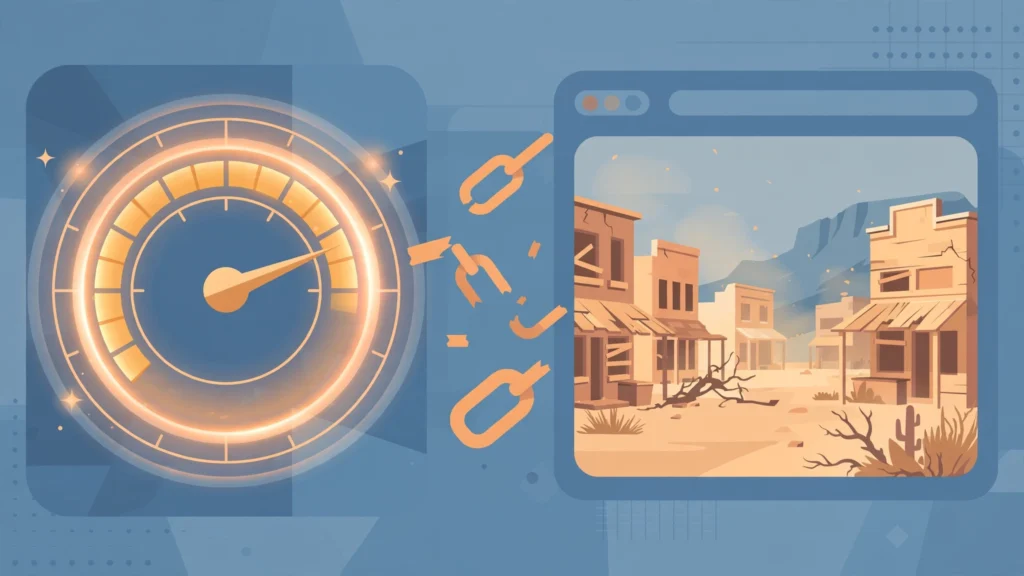
Picture this: a seller’s spreadsheet lands in your inbox offering a DR 70 guest post for $80. The Domain Rating looks elite. The price looks like a steal. You buy it, publish, and wait. Weeks pass. Your rankings do not move. You dig deeper and discover the truth: the site gets zero organic visitors, ranks for nothing, and publishes generic articles on every topic under the sun. You did not buy a backlink from an authority. You fell for the classic high DR no traffic backlinks trap — you bought a number.
High DR no traffic backlinks are the most common trap in the paid link market. Domain Rating is a third-party estimate of a domain’s backlink profile, not a measure of its real influence, and it is trivially easy to inflate. Understanding the gap between a shiny DR number and actual ranking power will save you thousands of dollars and protect your site from worthless — or worse, toxic — links.
Why High DR No Traffic Backlinks Are Worthless
Google does not use Ahrefs Domain Rating or Moz Domain Authority in its ranking systems. These metrics exist to estimate how strong a domain’s link graph appears to be. A site can accumulate thousands of backlinks — many from other inflated domains, directories, and link networks — and display a DR of 60, 70, or even 80 while earning no clicks from real searchers.
A backlink’s real job is twofold: pass ranking signals (authority) and send referral visitors who might click, share, or convert. High DR no traffic backlinks fail at both. A site with no organic traffic is, by definition, not ranking for anything Google considers competitive. If Google does not trust that site’s pages enough to rank them, a link from those pages carries very little trust to pass along.
The result is predictable. Link buyers report the same pattern again and again: their third-party DR climbs, their dashboards look impressive, and their money-site rankings stay flat. The only metric that moved is the one the seller optimized for.
How Domain Rating Gets Inflated (and Why Sellers Do It)
DR measures the quantity and DR-level of a domain’s referring domains. It does not measure traffic, relevance, editorial quality, or whether anyone actually reads the site. That makes it gameable in several cheap ways:
- Expired domains with legacy links. A buyer picks up an old domain that once earned real links, keeps the link graph, and republishes unrelated content. The DR survives; the audience does not.
- Link network cross-linking. Dozens of inflated sites link to each other in a closed loop, pushing every member’s DR up without a single genuine reader.
- Directory and footer link farming. Thousands of low-value links still move third-party metrics even when Google discounts them.
- Wikipedia-style parasite structures. A site rides the authority of links it did nothing to earn editorially, often on topics it no longer covers.
Sellers love DR because it is a single, impressive number they can put in a spreadsheet. “DR 70, $80” converts far better than the honest pitch: “real site, real audience, relevant topic, $400.” As one link buyer famously discovered, a seller sheet offered a DR 63 domain at $45 with literally zero organic traffic — the only thing that link moved was the buyer’s own DR, equally manufactured.
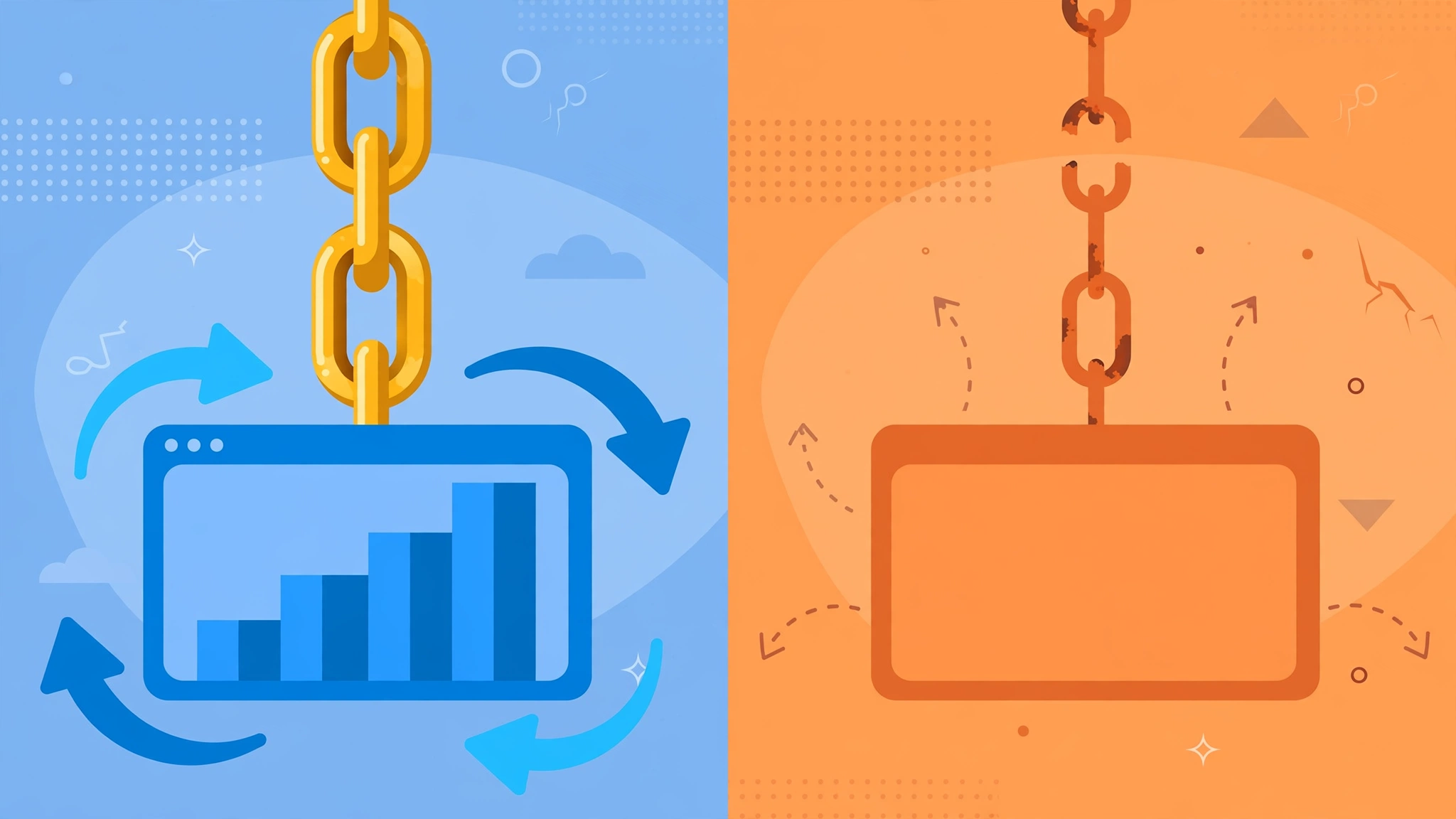
5 Red Flags That Expose Fake Authority Sites
Before you spend a dollar on high DR no traffic backlinks, run every prospect through this five-point check. Any single red flag should make you pause; two or more should kill the deal.
1. Zero or near-zero organic traffic
The single most important check. Open the site in your SEO tool of choice and look at estimated organic traffic. A genuine authority site in any competitive niche earns real search visits. If a “DR 65” site shows zero monthly organic visitors, the DR number is fiction for your purposes. Traffic trends matter too: a steep decline often means the site was hit by an algorithm update or manual action and never recovered.
2. No topical focus
Real publications have an editorial lane. Fake authority sites publish about crypto on Monday, CBD on Tuesday, VPNs on Wednesday, and “best lawn mowers” on Thursday. This scattergun coverage exists to sell guest posts to anyone, and it means your link lands in a topically irrelevant neighborhood — one of the weakest possible signals.
3. Thin, templated, or AI-slop content
Skim five recent posts. Are they generic, shallow, and interchangeable with a thousand other sites? Do they target obvious advertiser keywords with no original reporting, data, or opinion? Sites built to sell links rarely invest in content worth reading, because readers were never the point.
4. Obvious paid-link inventory
Search the site for phrases like “guest post,” “write for us” priced menus, or author bios linking to casinos, CBD stores, and essay mills in the same week. A site whose outbound links read like a link farm’s client list is passing that neighborhood’s reputation to you.
5. No real audience signals
Check for signs of life: comments, social shares, an email newsletter, an author with a real byline and presence. Authority sites have communities; link farms have contact forms. If nobody reads the site, your link sends zero referral traffic and — per Google’s own guidance on link spam and unnatural links — manipulative link schemes are exactly the kind of signal Google’s systems are built to ignore or penalize.
DR vs. Traffic vs. Relevance: What Actually Matters
When you are deciding whether buying backlinks is safe for your situation, rank your vetting criteria in this order:
| Signal | What it tells you | Weight |
|---|---|---|
| Organic traffic | Google actually ranks this site; it has real visibility | Highest |
| Topical relevance | The linking page’s topic matches yours | Highest |
| Editorial standards | Real review process, real authors, real audience | High |
| Linking page traffic | The specific page is indexed and visited | High |
| Domain Rating | Rough link-graph strength estimate | Screening filter only |
DR still has a legitimate use: as a coarse filter to build a prospect list. Filter competitors’ backlink profiles to DR 30+, then apply the traffic and relevance checks to find the sites actually worth pursuing. The mistake is stopping at DR and paying for it.
A DR 30 site with 20,000 monthly organic visitors in your niche will outperform a DR 70 ghost site nearly every time. The smaller site has something the ghost site lacks: Google’s demonstrated trust, expressed as rankings and traffic. That trust is what transfers through the link.

Why High DR No Traffic Backlinks Still Sell (and Who Profits)
If high DR no traffic backlinks are so worthless, why does the market keep selling them? The answer is simple: they are cheap to produce and easy to sell. A seller can acquire an expired domain for a few dollars, publish a handful of templated posts, and list it as “DR 60+” on every marketplace. Each guest post sold at $50–$150 is nearly pure margin, because there is no audience to serve and no editorial standard to maintain.
The business model depends on buyer behavior. Most buyers sort spreadsheets by DR, buy the highest number at the lowest price, and never check traffic. Sellers know this, so they optimize for exactly one thing: the DR column. Meanwhile, genuine sites with real traffic and strict editorial review charge more, publish fewer paid posts, and often reject off-topic pitches — which makes them look expensive next to the ghost sites.
The economics flip once you measure cost per ranking gained instead of cost per DR point. One $300 link from a trafficked, relevant publication that moves a money page from position 14 to position 5 is infinitely cheaper than ten $80 ghost-site links that move nothing. This is why experienced buyers happily pay 3–5x more per link: they are buying outcomes, not metrics. The sellers of high DR no traffic backlinks profit from the gap between what buyers measure and what actually ranks.
There is also a reporting trap. Agencies that sell link packages love DR because it always goes up — it is easy to report “your DR grew from 22 to 41” in a monthly PDF. Traffic and rankings are harder to move and harder to fake. If your vendor’s reports celebrate DR growth while your organic traffic flatlines, you are paying for the report, not the result.
What to Do Instead: Vet Like a Survivor
Experienced link buyers who survive in this market long-term share one habit: they screen on traffic and topical relevance, not DR. Here is a practical vetting workflow you can run in under ten minutes per prospect:
- Check organic traffic in Ahrefs or Semrush. Minimum bar: visible, stable or growing traffic; ideally thousands of monthly visits, not hundreds.
- Check the traffic trend over 12–24 months. Upward or flat is good; a cliff is a hard no.
- Verify the linking page is indexed in Google and ideally already ranks for something.
- Confirm topical fit. Would a reader of this site plausibly care about your content? If not, pass.
- Review outbound link quality. If the site links to spammy neighborhoods, your link inherits that company.
- Prefer niche edits on trafficked pages. A link inserted into an existing, already-ranked page starts working far faster than a guest post on a fresh URL that Google has never seen.
This process feels slower than buying off a DR-sorted spreadsheet. It is also the difference between links that rank and high DR no traffic backlinks that merely decorate your backlink profile while your traffic flatlines. Remember: inflated third-party scores are what sellers optimize for; rankings and revenue are what you should optimize for. Every dollar you redirect from ghost sites into real, trafficked, relevant publications compounds — in rankings, in referral traffic, and in the resilience of your link profile against future updates.
FAQs
Still on the fence about high DR no traffic backlinks? Here are the questions link buyers ask most before they spend.
Are high DR backlinks worthless if the site has no traffic?
Effectively, yes. A backlink’s value comes from the linking site’s real authority and visibility, not its third-party DR score. High DR no traffic backlinks come from sites Google does not rank, so they pass little trust and send zero referral visitors. They may nudge your own DR number upward, but that number is not a ranking factor.
Can a high DR no traffic backlink hurt my rankings?
Usually it just does nothing, but risk exists. Sites with inflated DR and zero traffic are often link farms, expired-domain rebuilds, or networks Google has quietly devalued. Associating your site with those neighborhoods can dilute your link profile’s quality, and manipulative link schemes fall under Google’s link spam policies, which can trigger algorithmic discounting.
Is Domain Rating a Google ranking factor?
No. Domain Rating is an Ahrefs metric; Domain Authority is a Moz metric. Neither is used by Google’s ranking systems. They estimate link-graph strength, which correlates loosely with rankings but can be gamed. Google’s own guidance emphasizes earning links editorially from sites with genuine authority, not optimizing for third-party scores.
How do I check if a site has real organic traffic before buying a backlink?
Use Ahrefs, Semrush, or a similar tool to check estimated monthly organic traffic and its 12–24 month trend. Look for stable or growing traffic in the thousands, not a flatline near zero. Also verify the specific linking page is indexed in Google and check the site’s top keywords — if it ranks for nothing relevant, walk away regardless of its DR.
What matters more for a backlink: DR or traffic?
Traffic, by a wide margin, combined with topical relevance. Traffic proves Google already trusts the site enough to rank it; relevance ensures the link’s context makes sense. Use DR only as a coarse screening filter to build prospect lists, then make final decisions on traffic, relevance, and editorial quality.
How many high DR links does it take to rank?
There is no fixed number, and chasing a count is the wrong frame. One contextual link from a trafficked, topically relevant site routinely outperforms dozens of high DR no traffic backlinks. Most content sites see meaningful movement from 15–25 quality, relevant links — the right sources matter far more than the total count or the average DR.
Stop paying for numbers and start paying for value: real traffic, real relevance, real audiences. Browse vetted link opportunities →