
Most rewrites in paid guest posting are not the writer’s fault. They are the buyer’s fault — because the order went out with a vague note like “write about SEO, add my link” and the publisher filled the gaps with guesses. A proper guest post brief fixes that. It is the document you send a publisher or vendor before a word is written, and it is the difference between a post you approve on first read and a three-round rewrite that still misses your anchor.
If you buy guest posts regularly, a guest post brief is not optional paperwork — it is your quality control system. This guide gives you the full template, plus the acceptance checklist, footprint-safety rules, and post-live verification clause most buyers never think to include.

What a Guest Post Brief Actually Is
A guest post brief is a buyer-side instruction document. It tells the publisher exactly what you want: the goal, the publication’s guidelines, the audience, the angle, the linking instructions, the tone, and the conditions under which you accept the draft and pay. It is not a pitch email, and it is not an outline on its own — it wraps the outline in the commercial terms of the order.
Unlike contributor-side pitch guides, which teach writers how to get accepted, your guest post brief teaches the publisher how to deliver what you paid for. The publisher knows their site, but only you know your money page, your anchor strategy, and your brand limits. Aim for one to two pages: longer briefs get skimmed, vague ones get improvised.
The Guest Post Brief Template, Section by Section
1. Goal and Target Page
State the single goal in one sentence, then name the exact target URL. “Build authority for our link-building services page” beats “get a good link.” Add the target page’s primary keyword so the writer can match the post’s topic to it naturally.
2. Target Publication and Its Guidelines
Name the publication and summarise its editorial guidelines: word count range, formatting rules, banned topics, and whether the site marks paid posts as sponsored. When you browse vetted sites in the marketplace, note each site’s rules here so the brief travels with the order.
3. Audience
Describe the reader in two lines: role, experience level, and what they are trying to solve. The writer cannot guess whether the audience is agency owners or in-house marketers.
4. Angle and Outline
Give the angle in one sentence — the fresh claim of the post — then a short outline of four to six headings. The outline is your best defence against generic filler: it forces the post to cover the subtopics you care about instead of drifting into a recycled definition.
5. Linking Instructions
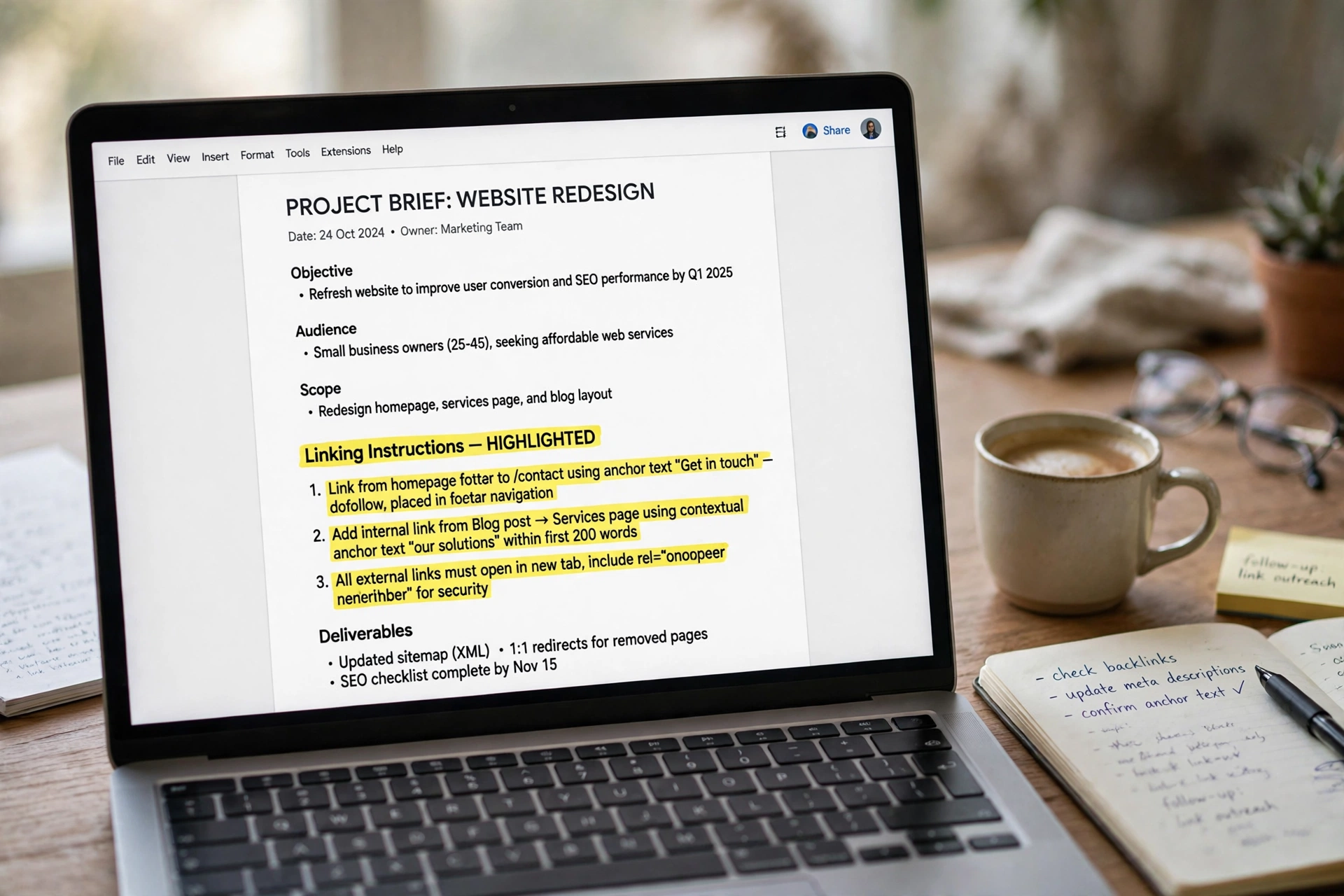
This is the section publishers get wrong most often, so be exact. State the money link URL, the exact anchor text, the section where the link must appear, and that it must be dofollow. Add the authority-link rule: one or two links to authoritative, non-competing sources, so the post reads like editorial content, not a link vehicle. Google’s guidance on qualifying outbound links is the standard to point writers to: Google’s outbound link guidance.
6. Tone and Voice Notes
Give three tone notes and one example sentence in your brand’s voice. “Professional but plain-spoken, no hype, short sentences” is usable; “good quality writing” is not.
7. Acceptance Criteria and Revision Terms
Write down what “done” means before the draft arrives: anchor placed exactly as briefed, dofollow confirmed, link in the agreed section, no additional promotional links, word count met. State how many revision rounds are included and the turnaround for each. This section alone prevents most disputes.
The Acceptance Checklist: Check Before You Approve
Do not approve a draft by feel. Run this checklist on every delivery:
- Anchor text matches the brief exactly, with no extra words inserted.
- The link is dofollow and points to the correct target URL.
- The link sits in the agreed section, not buried in the author bio or footer.
- No extra promotional links were added without your agreement.
- The post meets the word count and covers every heading in your outline.
- The tone matches your voice notes and the post reads naturally.
If any item fails, send it back with the checklist item named. Publishers fix specific complaints fast; they argue with vague ones.
Footprint-Safety Rules for Your Briefs
When you place many orders, your briefs themselves can leave a pattern. Vary the author bio, rotate anchor text instead of repeating one exact-match anchor, and change outline structures from order to order. A footprint is not created by one post — it is created by twenty posts that look templated. Note what to vary in the brief itself, especially for repeat orders with the same publisher.
Buying from a vetted channel helps here too. If you are comparing where to place orders, read the marketplace comparison in where to buy backlinks before committing budget to a new vendor.
The Post-Live Verification Clause
Write this clause into every guest post brief, word for word:
“The link must be live as agreed within 48 hours of publication. If the link is moved to a different section, changed to nofollow, or removed within the agreed live period, the publisher will restore it within 48 hours of notice or the placement is refunded.”
Most buyers check a post once at delivery and never again — yet links get moved in redesigns, stripped by editors, or quietly nofollowed months later. A verification clause gives you standing to demand a fix; a monthly spot-check catches the drift.

Conclusion
A guest post brief is a small document with an outsized return. Write the goal, audience, angle, exact linking instructions, tone, and acceptance criteria before you order, then check every delivery against the checklist and verify the link stays live. Buyers who brief properly approve posts on first read and pay fewer revision fees.
Frequently Asked Questions
How long should a guest post brief be?
One to two pages — long enough to cover the seven template sections, but short enough that the writer reads all of it.
What is the most important section of a guest post brief?
The linking instructions. Anchor text, target URL, placement section, and dofollow status are the details publishers get wrong most often, and the hardest to fix after publication.
How do I stop my orders from looking templated?
Vary the author bio, rotate anchor text, and change outline structures across orders. Note what to vary in the brief itself, especially for repeat orders with the same publisher.
What if the publisher moves or removes my link after publication?
That is what the post-live verification clause is for. It requires restoration within 48 hours of notice, or a refund — and it only works if it was written into the brief before the order.