If you have ever wished for the ranking power of a premium backlink without the full purchase price, link rental SEO promises exactly that. Instead of buying a link outright, you pay a monthly fee to “rent” a backlink placed on someone else’s website — and the moment you stop paying, the link disappears.
It sounds like a clever shortcut: instant authority, low upfront cost, total flexibility. But the trade-offs — vanishing rankings, Google spam-policy risk, a bill that never ends — rarely make the sales page. Here’s how monthly link rentals actually work, what link rental SEO really costs versus buying outright, and who (if anyone) should use them.
What Is Link Rental SEO?
Link rental SEO is the practice of paying a recurring monthly fee for a backlink hosted on a third-party website. Unlike a traditional purchased placement — where you pay once and the link stays live indefinitely — a rented link exists only as long as your subscription does. Cancel the payment, and the link is typically removed within days.
Most rental inventory lives on private blog networks (PBNs) or broker-controlled sites with pages that already carry authority. Providers usually offer homepage links (most power, most unnatural-looking) and cheaper, subtler inner-page links. You choose the target URL and anchor text; the provider places the link; you keep paying monthly to hold your position.
It’s leasing versus buying a car: faster and cheaper upfront, but you never own the asset and the payments never stop.
How Monthly Link Rentals Actually Work
Using a link rental SEO service follows a predictable, mechanical process:
- Pick a provider with rental inventory. Platforms list domains by niche, authority metrics, and price — price usually dictates the quality of the neighborhood.
- Choose placements and anchors. You select the sites and write the anchor text. Experienced buyers lean toward branded or generic anchors to avoid an obvious footprint — exact-match money keywords are tempting but dangerous.
- Links go live fast. Placement usually takes days, not the months that outreach requires.
- Monitor and renew. Every month you decide: keep paying to hold rankings, or cancel and risk the drop. Some providers add a free “buffer” layer of secondary links to soften velocity risk — but no buffer removes the underlying risk.
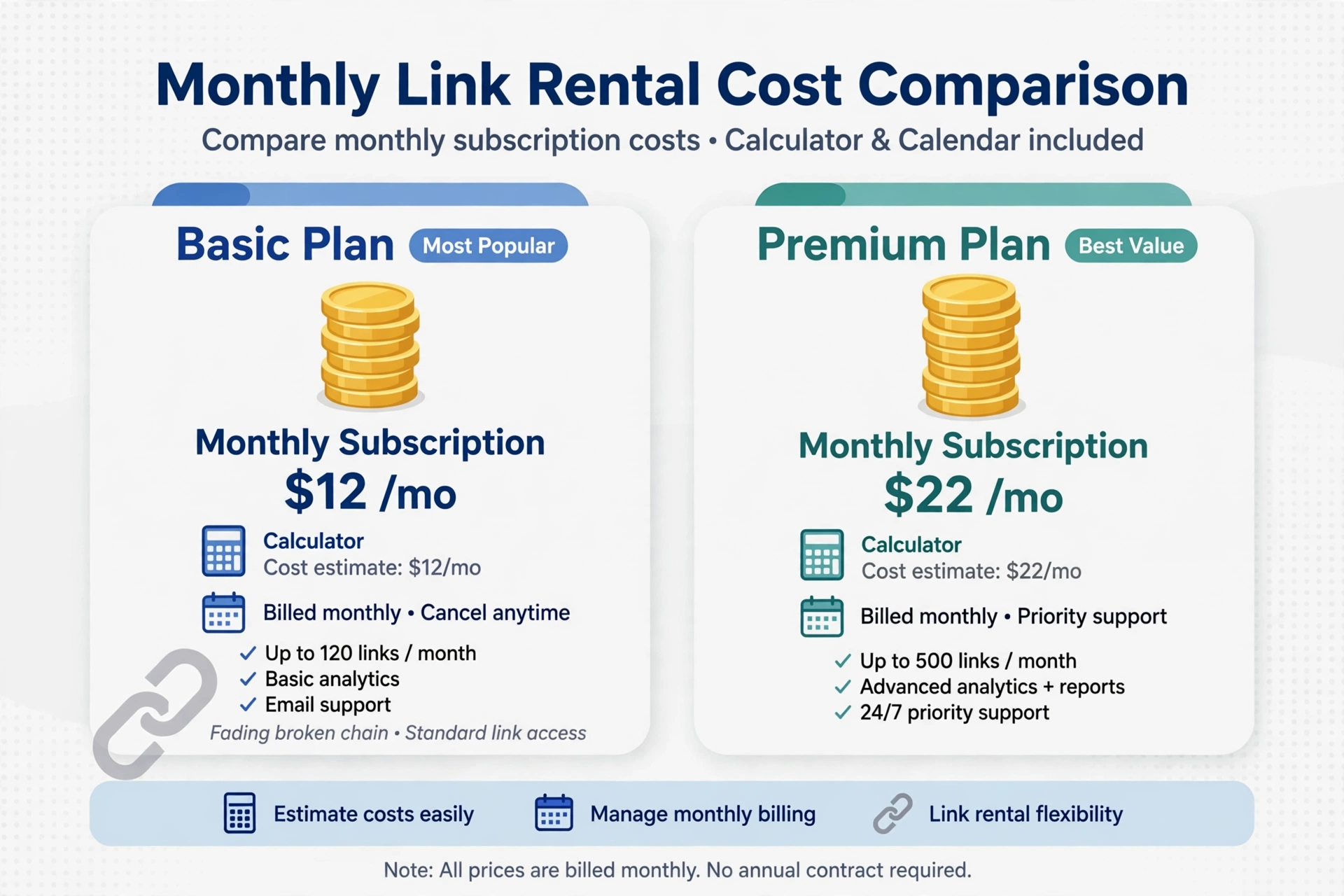
Link Rental SEO vs Buying Links Outright: The Real ROI Math
Here is the math sellers hope you never do. Industry data suggests the one-time price of a permanent (“eternal”) placement roughly equals 30 months of renting the equivalent link. Run the numbers:
- Rent a link at $15/month. After 30 months you have paid $450 — the same as buying it outright — and you still own nothing.
- Keep renting for 3 years and you have spent $540 with zero residual asset. Buy once at $450 and the link keeps working for free from month 31 onward, growing more valuable as the host site gains authority.
Renting wins only on cash flow and speed: ranking power this week for $15 instead of $450 today. On any timeline past ~30 months, buying wins. If your business will exist in three years, buying outright is almost always cheaper — see our guide to link building pricing models for the full breakdown.
The Risks Nobody Puts on the Sales Page
Three link rental SEO risks matter most:
1. Google treats paid links as spam. Google’s spam policies explicitly prohibit buying or selling links intended to manipulate rankings — rented or not. Detection is algorithmic (spam filters spot unnatural add-and-remove patterns) or manual (a reviewer notices twenty high-authority links appear Tuesday and vanish Friday). Either can crater your traffic.
2. The link-loss curve is brutal. When a rental ends, the authority signal vanishes instantly. Without earned, permanent links underneath, rankings don’t gently decline — they fall off a cliff.
3. Dependency. Your rankings become hostage to a monthly bill — and to the provider’s survival. If the rental network gets deindexed or goes bust, your links vanish overnight through no fault of your own.

Don’t Confuse It With “Rank and Rent”
You will also encounter “rank and rent” — a different model where you build and rank your own lead-generation site, then rent the incoming leads (not links) to a local business for a monthly fee. Unlike link rental SEO — where you rent backlinks to boost your site — rank and rent means renting your ranked site’s leads to someone else. Don’t mix them up when evaluating an offer.
7 Contract Red Flags Before You Rent a Link
Before signing any link rental SEO contract, watch for these red flags:
- No replacement guarantee — if a host page gets deindexed, will they swap in an equivalent placement free?
- Painful cancellation — can you cancel in one click, or does it require a “retention call”?
- No placement transparency — if they won’t show you the actual pages before you pay, walk away.
- Footer-only placements sold as “premium” — buried links pass little value.
- Forced exact-match anchors — money keywords over branded anchors serve the sale, not your safety.
- No exit reporting — you need a full list of every rented URL so you can replace them later.
- No contract at all — handshake deals mean your links can vanish with zero recourse. See what a proper agreement looks like in our link building contract guide.
Who Should (and Shouldn’t) Rent Links
Link rental SEO can make sense for testing a keyword before investing in permanent links, for short-term campaigns with a defined end date, or in niches where rentals are the competitive baseline and you need data fast.
Never rent for your brand’s money site, for client sites without full written transparency, or for any long-term project. Building on rented land is building on sand.
Frequently Asked Questions
Is link rental SEO safe?
No. It violates Google’s spam policies on paid links, creating algorithmic and manual-penalty risk. Fast ranking spikes are possible, but the safety profile is poor versus earned or permanent links.
How much does link rental SEO cost?
Bulk inventory runs roughly $1.20–$1.85 per link per month; higher-authority placements cost $15–$50+. Remember the 30-month rule: renting longer usually costs more than buying outright.
What happens to my rankings when a link rental ends?
Expect a sharp drop. The signal vanishes the moment the link is removed, and without permanent links underneath, Google reads it as artificial popularity fading. Have an exit plan: permanent placements ready before you cancel.
Are rented links the same as PBN links?
Not exactly. A rented link is defined by its payment model — monthly fee, gone on cancellation. Most rental inventory lives on PBNs, but rentals can also come from broker-controlled real sites. The payment model is the core risk; the PBN is an extra one.
What’s better: renting links or guest posts?
Guest posts are permanent assets — slower, but the link stays. Renting is pure speed with zero residual value. For anything you’ll own in three years, guest posts win on ROI and risk. Still weighing paid options? Read Google’s link spam policy explained for link buyers first.
The Bottom Line
Link rental SEO is a tool for speed, not for building. It can reveal whether a keyword is winnable or power a short campaign — but every month, you pay for an asset you’ll never own, under rules Google explicitly forbids. If your site matters long-term: rent to test, then buy to keep. Browse vetted permanent placements instead of another monthly bill.