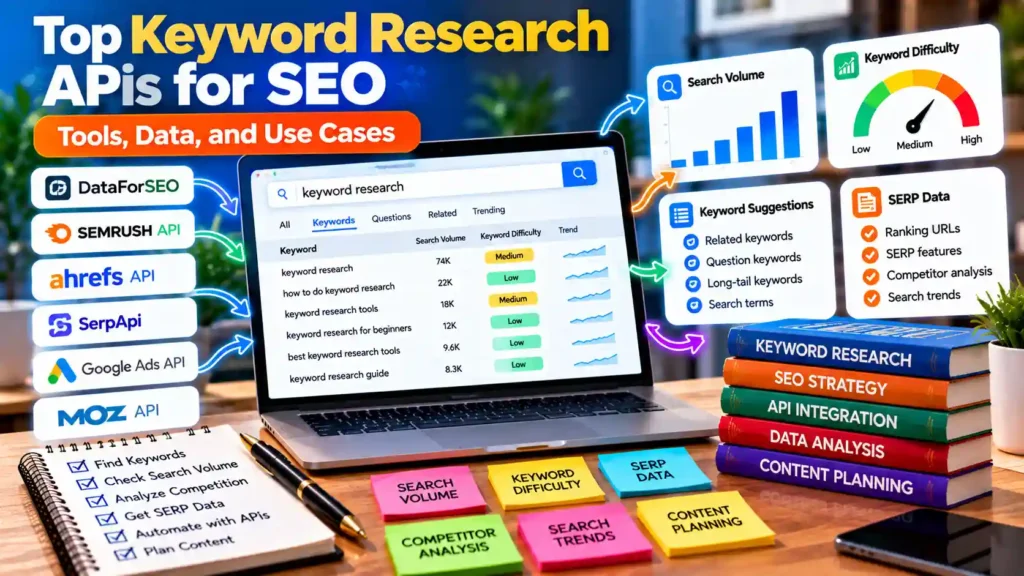
Keyword research is an important part of any SEO strategy. It helps you understand what people search for and what type of content they want.
Normal keyword research tools work well for small projects. But checking thousands of search terms by hand can become time-consuming.
This is where keyword research APIs can help.
An API can collect keyword and SEO data automatically. Agencies, developers, publishers, and SEO platforms can use this data for content planning, reporting, competitor research, and SEO automation.
What Is a Keyword Research API?
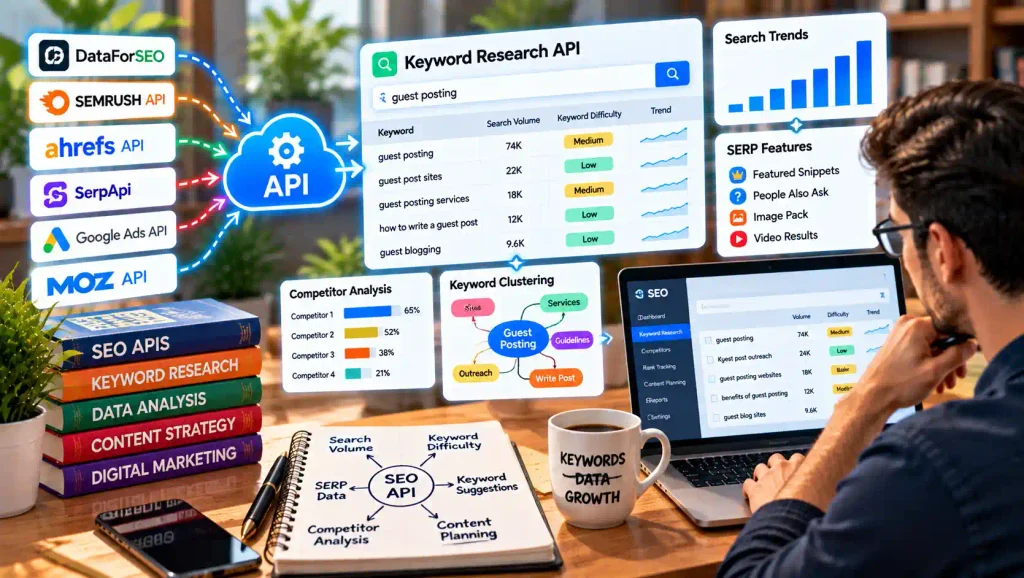
A keyword research API allows software to request keyword information from another service.
Instead of entering keywords manually into an SEO tool, your application sends a request to the API. The API returns the requested data.
A keyword data API may provide:
- Keyword search volume
- Keyword difficulty
- Keyword suggestions
- Search trends
- CPC data
- SERP data
- Keyword rankings
- Competitor information
- SERP features
This makes it easier to process a large keyword list without checking every keyword manually.
Why Use Keyword Research APIs?
APIs are useful when you need SEO data at scale.
Imagine an agency managing many websites. Checking thousands of keywords every week would require a lot of manual work.
An SEO keyword API can automate parts of this process.
Common uses include:
- Keyword research
- Competitor analysis
- Keyword clustering
- Rank tracking
- Content planning
- SERP analysis
- SEO dashboards
- Content creation
- Competitive analysis
- SEO automation
APIs can collect and organize data while your SEO team focuses on making decisions.
What Data Can Keyword APIs Provide?
Different SEO APIs provide different types of information.
Before choosing one, decide what data your project actually needs.
Keyword Search Volume
Keyword search volume estimates how often people search for a keyword.
For example, you could compare the search demand for:
- SEO tools
- Keyword research tools
- SEO software
Search volume can help you find popular topics.
However, it is an estimate. Different providers may show different numbers.
Do not choose a target keyword only because it has high search volume. Relevance and search intent also matter.
Keyword Difficulty
Keyword difficulty estimates how hard it may be to compete for a search query.
Different SEO tools use different methods to calculate this metric.
One platform might show a difficulty score of 30, while another shows 40 for the same keyword.
Use keyword difficulty as a guide, not a guarantee.
Keyword Suggestions
Keyword suggestions can help you discover related terms.
For example, if your starting keyword is “link building,” an API might return:
- Link-building strategies
- What is link building?
- Link building services
- Backlink building
- Link building for SEO
These relevant keywords can provide new ideas for a page or blog post.
Search Trends
Search trends show how interest in a keyword changes over time.
Some topics stay popular throughout the year. Others are seasonal.
Trend data can help you decide when to create or update content.
SERP Data
SERP data provides information about search engine results.
Depending on the provider, it may include:
- Ranking URLs
- Ranking domains
- Search positions
- Page titles
- Featured snippets
- Images
- Videos
- Other SERP features
This information is useful for SERP analysis because you can see what currently ranks for a keyword.
Popular Keyword Research APIs
Several providers offer keyword or SEO API access.
Common options include DataForSEO, Semrush API, Ahrefs API, SerpApi, Google Ads API, Moz API, Serpstat API, Keywords Everywhere API, and ValueSERP.
Each provider offers different data, pricing, limits, and features.
One may focus on SERP data, while another may provide stronger keyword or competitor information.
Always check current documentation before choosing a service because API products and pricing can change.
What Is the Best Keyword Research API?
There is no single best keyword research API for every project.
The right choice depends on your needs.
Before choosing one, ask:
- Do I need search volume?
- Do I need keyword difficulty?
- Do I need SERP data?
- Do I need keyword suggestions?
- Do I need competitor information?
- Which countries and languages do I need?
- How many API requests will I make?
- What is my budget?
A developer building a SERP tracking tool may need different data from a content team researching keywords.
Keyword APIs vs. Traditional Keyword Research Tools
Traditional keyword research tools normally provide a visual dashboard.
You log in, enter a keyword, and study the results.
An API works differently.
It allows your own software to request that data automatically.
For example, you could build an SEO dashboard that automatically collects:
- Search volume
- Difficulty
- Keyword rankings
- SERP results
- Related keywords
This is useful when manual research is too slow.
Keyword APIs vs. Google Keyword Planner
Google Keyword Planner is mainly designed for Google Ads.
It provides keyword ideas and advertising-related search data. SEO professionals can also use it for keyword research.
A dedicated keyword API may offer additional information such as
- Organic SERP results
- SEO difficulty
- Competitor keywords
- Ranking pages
- Keyword clustering information
The right choice depends on your project.
Google Search Console and Keyword APIs
Google Search Console provides data about how your own website performs in Google Search.
It can show:
- Search queries
- Clicks
- Impressions
- Average positions
A keyword API can help you research the wider search market.
Using both can help you find keywords you already rank for and new opportunities you have not targeted.
Google Analytics and Keyword APIs
Google Analytics helps you understand what visitors do after reaching your website.
A keyword API focuses more on keyword and search data.
For example, an API can help you choose a topic. Search Console can show how the page performs in Google Search. Google Analytics can then help you study visitor behavior.
These tools serve different purposes but can support the same SEO strategy.
Keyword Clustering With APIs
Keyword clustering means grouping similar keywords together.
For example:
- What is guest posting?
- Guest posting meaning
- What does guest posting mean?
- Guest blogging meaning
These keywords have similar intent.
Instead of creating four separate articles, you may cover them on one strong page.
An API can collect thousands of keywords. A system can then organize similar searches into groups.
This makes large-scale content planning easier.
Building Topic Clusters
Topic clusters organize related content around one broad subject.
For example, an SEO topic cluster could include:
- Keyword research
- Technical SEO
- On-page SEO
- Link building
- Guest posting
- Local SEO
Keyword APIs can help find relevant keywords for each topic.
These terms can then be organized into a clear content plan.
APIs for Content Creation
Keyword APIs can support content creation by collecting useful research before an article is written.
For a target keyword, an API may collect:
- Related keywords
- Questions
- Search volume
- Competitor pages
- Search intent
- SERP features
This data can help a writer understand what users want.
However, keyword data should guide the article, not control every sentence.
Content still needs to be useful and easy to read.
SEO Automation With APIs
SEO automation is a major use case for APIs.
An automated system can:
- Collect keyword metrics
- Check rankings
- Find new keyword opportunities
- Track search trends
- Monitor competitors
- Analyze SERPs
- Create reports
- Update dashboards
This can save time on large projects.
However, human review is still important. A keyword may have good numbers but still be a poor fit for your audience.
How to Choose an SEO Keyword API
When choosing an SEO keyword API, check several areas.
Data Coverage
Check which countries, languages, devices, and search engines are supported.
Available Data
Make sure it provides the metrics you actually need.
Documentation
Good documentation should explain authentication, endpoints, requests, responses, and errors.
Pricing
Some APIs charge per request. Others use credits or subscriptions.
Estimate your expected usage before choosing a plan.
Request Limits
Large projects may require many API requests. Check the limits before building your system.
Limits of Keyword API Data
Keyword API data is useful, but it is not perfect.
Search volume is an estimate.
Keyword difficulty is also an estimate.
Different providers can return different numbers for the same keyword.
Search results may also change by location, device, and time.
Use API data together with search intent, real search results, audience needs, and human judgment.
Frequently Asked Questions
What Is the Best Keyword Research API?
The best keyword research API depends on your budget, required data, country coverage, request volume, and project needs.
What Is a Keyword Data API?
A keyword data API lets software automatically request keyword information such as search volume, difficulty, related terms, and trends.
What Are SEO APIs?
SEO APIs provide SEO data to other software. They may offer keyword, ranking, backlink, traffic, domain, or SERP information.
Can Keyword APIs Help With Competitor Analysis?
Yes. Some APIs provide competitor keywords, ranking pages, positions, and SERP information for competitive analysis.
Can APIs Find Featured Snippets?
Some SERP APIs can show whether featured snippets or other special search features appear for a keyword.
Do I Need Coding Skills?
Usually, yes. API integrations often require knowledge of HTTP requests, authentication, JSON, and languages such as Python, PHP, or JavaScript.
Final Thoughts
Keyword research APIs can make SEO research faster and easier at scale.
They can provide keyword search volume, keyword difficulty, keyword suggestions, SERP data, search trends, keyword rankings, and competitor information.
They can also support keyword clustering, topic clusters, content planning, content creation, competitor analysis, and SEO automation.
There is no single best API for every project. Compare data coverage, pricing, request limits, documentation, and available features.
Most importantly, do not rely only on API metrics.
Combine them with real search results, Google Search Console, Google Analytics, audience research, and human judgment for a stronger long-term SEO strategy.